If you’ve ever felt stuck in the frustrating cycle of run, injury, rest, repeat, you’re not alone. Many runners experience setbacks at some point in their journey, whether they’re training for their first 10k or preparing for a marathon. Learning how to recover from a running injury and safely manage your return to training can make all the difference to your long term progress.
Returning to running after an injury is about more than simply waiting until the pain disappears. It involves rebuilding strength, improving recovery habits and approaching your training in a smarter, more sustainable way so your body can handle the demands of running.
To help you stay healthy and keep chasing your running goals, we’ve partnered with insole specialists Enertor to share expert advice from physiotherapist Tom Harrison of PacePhysio. With years of experience helping runners overcome persistent issues, Tom explains how you can recover properly, build resilience and get back to running stronger than before.
Read on to discover his practical framework for how to recover from a running injury, reduce future setbacks and enjoy running for the long term.
Are you a passionate runner but seem to spend more time going from one injury to another than actually being able to run? If this sounds familiar, you aren’t alone. Research would suggest that 25% of distance runners are injured at any given time and around 50% have to take time off running due to an injury over a 12 month period. Whilst running is a high impact sport, we can do better in reducing the associated injury rates through sensible training and a better awareness of the things we can do outside of running to reduce future injury risk.
Below are three key questions you need to be asking yourself if you are an injury-prone runner. If the answer is no to any of these then prioritise the advice given to reduce your chances of future injuries, and to get back to running without a hitch.
Adequate recovery is essential to reduce running-related injuries, but many of us are getting it wrong. There are endless gadgets to choose from these days to aid recovery, from ice baths to compression boots. Yes, they may help to some degree but if you are not nailing the basics then the effects might be minimal. There are three key areas that experts believe are the most important when it comes to the basics of recovery: sleep, fueling and psychological stress management. Let’s expand on these a little more…:
There is no hiding from the fact that the demands on our muscles during running are huge. Whilst most of the peak muscle forces increase with faster running speeds, some are constant throughout. The soleus, a deep calf muscle, has to manage forces around six times our bodyweight at all paces (increasing to around eight times during sprinting). Ultimately, our muscles and tendons need to be very strong to be able to run effectively and minimise injury risk.
Runners can use a number of simple tests to determine whether they are ‘strong enough’ to run. Whilst there is no exact science to how strong each runner needs to be, results from these tests can identify individual weaknesses to work on:
1. Calf raise endurance test: at least 25 reps for males and 20 for females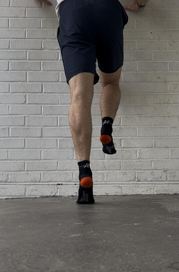
This is possibly the most important test given that the calf musculature contributes to over 50% of the propulsive force during each step whilst running.
This should be done at a strict tempo of one second up, one second down. It is also important to stop if your form starts to break down. For example, starting to bend at the knee and push from the thigh muscles, losing height of the calf raise
and not keeping up with the strict tempo of the repetitions are all signs the calf can no longer tolerate the test and it should be stopped.
2. Single leg bridge test: at least 20 reps for males and 15 reps for females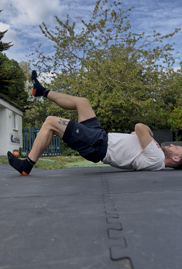
This provides us with a good measure of your hamstring and larger glute muscles, both of which have a huge role when absorbing the impact of landing when we run. Set up by lying flat on the floor with your knee at 90 degree angle, heel on the ground and arms across your chest. Again, aim for a strict tempo of one second up, one second down whilst driving your hips off the ground until you are parallel with your torso
3. Single leg hopping on the spot: aim to complete with good control for 20
seconds (males and females)
Given that the nature of running requires us to react quickly to the ground from
one step to the next, hopping can be considered the closest exercise to simulate
many of the forces and demands of running. Hence, we need to be able to hop
effectively to run. For this test, you want to be hopping in one place for at least
20 seconds. You should be landing and taking off with good control in the same
place on the floor. You are not trying to achieve maximum height each hop but aim for around 50-60% of maximal effort. 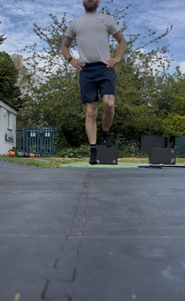
Comparing both limbs on these tests can identify any single leg weaknesses. If you are falling short on any of the tests in either one or both legs you need to focus on strengthening these muscle groups. As a starting point, you can use the same tests as home-based exercises to practice but going forward it may be worth working with a physiotherapist or strength coach to create a strengthening plan.
Bonus tip: Whilst having strong muscles is so important to deal with the forces associated with running, we can also use footwear and insoles as a measure to reduce some of the impacts of running resulting in less stress on our body.
This is arguably the most boring but also the most important aspect of injury prevention.
Training errors are the number one reason for running-related injuries. When it comes to
running, We like to think of three key variables that need to be carefully considered:
As a simple rule of thumb, injuries are much more likely to occur if trying to increase more than one of these variables at any given time. This is where many people make errors and often training plans will try to increase both weekly volume and running intensity at the same time.
Some individuals are able to deal with this increased stress on the body, but many aren’t. When it comes to returning from injury, we suggest the following approach:
Recovering from injury can be frustrating, but with the right approach it can also be an opportunity to rebuild stronger foundations for your running.
By focusing on the basics of recovery, improving strength and taking a sensible approach to training, returning to running after an injury becomes far more manageable and sustainable.
Ready to put that knowledge into practice? Explore the latest running events and charity races available through realbuzz and find your next challenge. With guaranteed entries to some of the world’s most exciting races and expert training support, you can set a new goal, run for a cause you care about and get back to doing what you love most.
Find a charity running event with realbuzz today.